Wednesday, 10 June 2015

Customer Swervices - Friday Flash


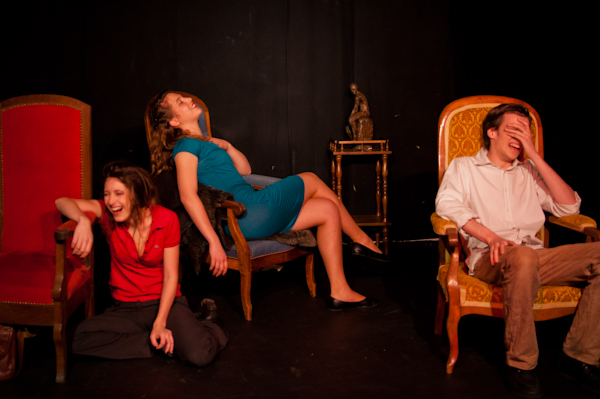
The Customer Services Liaison was explaining to him why his scheduled journey had been cancelled. He realised he was stood there with his arms were crossed which seemed a touch vehement, so he unfolded them and clasped them behind his coccyx while he listened to her bull. Her words jangled and reverberated in his ears even though they were delivered with mellifluous cadence. It was like being informed of a family bereavement in sing-song tones. Not that a family bereavement equated to a cancelled journey. Yet him being stood still in place rather than in motion was the bottom line, so all the rest was florid superfluity. Nevertheless he knew from previous experiences with the likes of this customer’s swervices ilk, that it behoved him to remain calm and not lose his temper, if he had any shot at satisfactory redress. He scrutinised her corporate uniform. He wanted to see if it was shoddy or sleek. Although neither really determined the heft with which he should treat her words. She could still be slick with her disavowals even shod in a flimsy manmade fabric, just as clad in quality wool twill might make her complacent in her pre-ordained patter. He wanted to see beneath the tissue, to scan for any guilty pigmenting of the skin. He wanted to smell her fragrance, to see if he could sniff out her respiring lies, but the synthetic terminus atmosphere prevented any scents from spooring on the air. She had paused in her soliloquy, adjudging for his response, with moistened finger held up to the windsock of his face. He grasped her hand and shook it. A brief connection solely in order to break their engagement entirely. A man shaking a woman by her hand felt all wrong. He wanted to kiss her, to stop up her insincere mouth, but knew that was unseemly. 


He marched back over to his partner. She stood there with her own arms crossed but made no move to relent her angular fury. He began to relay the bare bones of what he had been told. Her eyes widened as she challenged him to the usual semiotic interpretation of a handshake at the end of transacted business. He could not admit to her that it merely signalled his desperation to end the unsuccessful conference. Instead he found himself giving a fuller rendition of the liaison officer’s justifications. He had taken her role and was reiterating the very same discourse, with his partner playing him. Only a superior more imposing version of him. How had he wound up being the proxy for the corporation that had failed him, them so unutterably? He too was professionally besuited, but not branded like the liaison. he had very different stakes in this exchange than had the functionary. He knew the arguments he was mustering would brook no weight with his partner, how had he allowed them to do so with himself? Had he become distracted by her peregrinity and so allowed her to daintily ride roughshod over him? Whereas his partner knew him intimately, so would in no way be swayed by his allure, more familiar than institutionally unctuous. She was fully aware of just how and where his body blushed, while she could unfailingly detect his reek of petty deceit. He could see it in her eyes, her determination to sweep him aside and march over to the woman and have it out with her. Maybe woman to woman she might garner satisfaction, where woman to man he could not, with either of these females. He knew he had two options. He could grab her arm and pull her back. Or he could just shake that hand and take his leave of his partner as he had with the liaison officer. And in this situation, he could in fair propriety stop up her all-to-sincere mouth with a kiss. 


Monday, 8 June 2015

My Ten Favourite Stage Plays

Before I wrote fiction, I wrote stage plays. I used to see a lot of contemporary plays staged and also read a lot of scripts as part of my self-education programme. Though I don't go to the theatre much these days, here is a chart of my favourite plays. I've only included plays from the post-Second World War period onwards, otherwise it might be pretty Shakespeare & Brecht heavy in the chart!


10) "Royal Hunt For The Sun" - Peter Schaffer
I only ever read this rather than saw a performance, but I remember being struck by the amazing visual images that came across from the stage directions alone, the main one being a giant sun. It's the story of conquistadores in Latin America and the political dance around the Meso-American god-king to try and ensure a successful conquest with a tiny amount of men against a whole nation.


9) "No Exit" - Jean-Paul Sartre
I love Sartre more as a playwright than a novelist. But in truth most of his plays while readable, are unperformable. However this perfect little nugget of a play sees the threeway power struggle of prisoners in a locked room, trying to manoeuvre for power even though they have none in their situation. By turns they seduce, wheedle, cajole each other, always forming and breaking alliances. It's an early precursor of the "Big Brother" TV show, only with a killer pay-off line, "Hell is other people".


8) "The Balcony" - Jean Genet
Genet understood the illusion of the theatre better than most and a recurring theme of his was characters dressing up and acting as other characters. Here a revolution is taking place, but the action is being mirrored in microcosm inside a brothel, where punters are dressing up in fantasy roles as Judge, General and Priest, replacing the very same outside who have become victims of the coup, thus perpetuating the status quo. Sex, death and corruption, what more could you want on stage?


7) "Accidental Death Of An Anarchist" - Dario Fo
You've got to have a bit of humour haven't you? I always thought theatre audiences were so desperate to laugh, they would go into fits at the weakest of jokes in tired drawing room dramas. But this was a genuinely funny, laugh throughout the 90 minutes satirical farce with some acute political observations. All the more remarkable that it was based wholly on an incident from Italy and dissected Italian politics, yet it absolutely managed to translate both its message and its comedy to other countries. Part of this was down to recognisable character types, such as the dim-witted policeman, or the hero who disguises himself, the sultry temptress, but the nature of farce itself is also quintessentially recognisable.


6) "Comedians" - Trevor Griffiths
I only saw a student production of this, but it was still terrifying and visceral. A play about alternative comedy before anyone had even come up with that term. The premise is that an old pre-war comic is coaching a night-class of comedian-wannabees for a talent show night, when his star pupil throws his whole act in the bin and performs a brutal and in the face of the audience menacing routine instead. The only weakness of the play is the short and cop-out third act, when the old comic talks about the nature of humour set against and grounded in his own experiences of liberating a concentration camp when he was in the British army. I don't think that apologetic third act was required at all.


5) "White Rose" - Peter Arnott
I saw this at the Edinburgh Fringe Festival and of the 40 shows I crammed in my time there, this was head and shoulders the best. But you won't even find a copy of the script available on Amazon. It was in a theatre so small that it didn't even have a stage, but that perfectly suited its small scale for 3 actors. Set in World War Two Russia, a male fighter pilot, a female fighter pilot (the eponymous 'White Rose' and their shared female engineer, beautifully enact their triangular relationships, taking in the war, gender, love, patriotism, politics and just what it means to be human in the face of extremes and the prospect of death.


4) "AC/DC" - Heathcote Williams
The enfant terrible of the UK stage in the 1960s, which is saying something given the obsession with sex that abounded once plays were no longer censored by the offices of the Lord Chamberlain after 1968. This play was so prescient about all things that would go on to become our obsession with celebrity. It's visceral and yet has stunningly powerful visual imagery. I'm not sure how it would hold up to scrutiny today, simply because what it portrayed has now become so commonplace. But a work of genius to be sure.


3) "Marat/Sade" - Peter Weiss
A powerful play about the French revolution and how political dissidents were locked up in insane asylums. Thus it explores that boundary between revolutionary/radical thinkers and the mad, while also examining the propensity for change within the individual and across whole societies.


2) "Geography of a Horse Dreamer" - Sam Shepard
I think of all playwrights, Shepard has my favourite body of work. It's hard to pick just one. But there were a few plays he wrote in exile in the UK, looking back at his home country of the US and this is one from that period. It's small but perfectly formed, as a cowboy is kidnapped by gangsters because he has a special gift for forecasting winning racehorses so they can clean up at the bookies. However, cut adrift from his Wyoming home, the cowboy is losing his mind and his touch, whereupon the gangster captor is getting more desperate to restore his powers, while his doctor sidekick is more keen to isolate the creative energy by culling his body parts. The cowboys' brothers turn up to rescue him and return him to the range. Shepard's psychic pain at being cut off from his own home roots are encapsulated in this perfectly.


1) "Endgame" - Samuel Beckett
No one 'got' theatre like Beckett in my opinion. I think because real life amused him and was absurd and illusory as the stage itself. Life was a play and not a very logical or coherent one at that. Everyone cites "Godot" of course, but I believe this is a far superior play. One character Hamm is unable to stand, his antagonist Clov unable to sit. Hamm's parents both live inside dustbins. It's bleak and dystopian and nihilistic but it is also funny and moving and has stark, stripped down visually imagery that is so powerful. When life is so painfully absurd, all you can do is laugh at it, which is exactly what Beckett has us do. It's one of those plays that is so all-absorbing, the audience are no less captives in the theatre than the characters on stage, until the houselights come up to release them... into a world as absurd and illogical outside the theatre's doors. For the duration of the play, there is no outside world, no fourth wall of separation. A masterpiece.


Friday, 5 June 2015

Rock Cake - Flash Fiction

The first intimation they missed was when the sky suddenly darkened. Not the sky across the oceanic vista they were lovingly gazing out towards, but the sky immediately above their canopy as a shadow began to shroud their idyllic platform. They had hoped for a shooting star to mark their union, but they felt they could accept an eclipse, even if it proffered the imagery of the lights going out. 

The second pointer they missed was their wedding photographer fleeing his assignment, leaving his camera to spill to the floor in his haste to skedaddle. To be fair, since he had been stationed  behind them taking a shot of them looking out to the ocean, it was perhaps not entirely unsurprising that they remained unaware of his deletion from the scene.

The third inkling ought to have been when the columns of their belvedere began to buckle and bend as the downward thrust on its roof increased. They imagined they might be about to be caught in the middle of a tropical cyclone, though all remained calm out at sea in front of them. 

The fourth prompt was as the pressure increased, both developed nose bleeds. She was distraught as the blood stained her wedding dress, while he winced at the thought of the likely lost deposit on his tuxedo as the blood spurted on to it.


The conclusive affirmation was when the canopy was lifted off its pillars and a giant hand swept down and plucked them both up and popped them into a huge maw. The giant loved the taste of wedding rock cake. The first tier made from the stone, the second from the fondant wood and silk of the belvedere and the tasty final topper of bride and groom, though the chewy texture of the bride’s dress could sometimes get stuck between the giant’s teeth. But then he would employ one of the belvedere’s pillars as a toothpick. 


Story from following prompt provided for by Short Story & Flash Fiction Society


Monday, 1 June 2015

My Top TV Tunes

Thought I'd share with you my favourite TV theme tunes. Some are for programmes that weren't all that good, not even in a camp or ironic way, yet the theme tune still salvages some value in them. Sadly themes such as "Hawaii 5-0" and "Thunderbirds" have become ruined for me by drunken chorus renditions of them searing into my brain at many an end of season football team drink-up, or just some witheringly bad adolescent disco, no fault of the songs themselves really. Nor have I included movie themes (otherwise "Shaft" would be at number one and "The Pink Panther" at two, but look at the bright side, it rules out "Bewitched" and "The Brady Bunch") and I'm afraid there are whole rafts of programme types I don't watch and therefore am blissfully unaware of their blindingly good theme music for shows about properties and holidays.


10) Roobarb and Custard - The distortion and the slightly off harmonica make this really very 'muso' as well serving perfectly for a consciously garishly ill-drawn cartoon that shaded outside the drawn boundaries of its characters.


9) The Odd Couple - Just oozes swing and class, this was hipster chic before it was invented down Hoxton way. Series was pretty good too.


8) The Avengers - Sure it's cheesy and over the top, but then that was the aesthetic of the programme. Emma Peel and Purdey right? This almost has a Lee Hazelwood vibe to it (he of Nancy Sinatra collaborative partner fame).


7) Joe 90 - Not the best tune in the world, but this is Mod and Carnaby Street and every 1960s documentary about swinging London you'll ever watch. Even though it's actually scifi about some dreadfully unfashionable geek.


6) Voyage To The Bottom of The Sea - These puppet/animatron shows from the 60s & 70s all sort of blur into one in my dim and distant memory. Stingray, Captain Scarlet, Space 1999, Fireball XL5. But one thing about them all, they had pretty fine theme tunes. This show wasn't one by puppet-master Gerry Anderson. Good tune still.


5) Jackass - Never watched the programme in my life, but it's theme tune is from one of my fave bands The Minutemen. It's called "Corona" which is kind of the opposite to the void heart of Steve-O and his cronies. Still, someone in their production company had impeccable music taste. I know it's a film, but my blog, my rules okay? Interestingly someone rigorously keeps slapping a copyright claim on the theme tune, so that gives me the excuse to give you the original as well.


4) Twilight Zone - Eat your heart out X-Files. The original and the best in eerie, unexplained creepiness.


3) The Persuaders - Written by John Barry so you know it's going to be good right? The hint of an Iron Curtain musical theme sets it up just right


2) Test Match Cricket - For such a slow, languid sport this is really rather breakneck in pace. Brings back so many lazy summer days as a youth waiting in anticipation for the clock to tick round to 11am and a full day slumped in front of the telly while the sun was beating down outside. Or, when it was chucking it down and the BBC were restricted to showing reruns of old matches, the jaunty Caribbean upswing of this made the rain outside seem very far away.


1) The Sweeney - Great show, great theme tune. The way the police car siren segues into the theme tune is genius (unfortunately not on this YouTube version) and the theme itself manages to conjure up the suggestion of violence, seediness and corruption that the show portrayed. The closing track was a slower, more reflective version of the theme. The Sweeney was unusual for its time because the cops didn't always get their man. Now I watch it and am flabbergasted at just how much my city of London has changed in the 40 years since this aired. It looks like another world.

Friday, 15 May 2015

Lux - Flash Fiction


I have been exposed to the light just the once. The occasion of the expulsion of my birth. Tumbling from the primordial interstitial paradise, into a searing light that sundered the milky membranous veil from my eyes. Reflexively I averted my head and pressed it into the cold breast of my mother who had expired from the moil of evacuating me. Burying my face into her clabbered flesh blotted out the punishing light and stopped up my incipient breath. These twin inundations red-illuminated the arteries behind my own eyes and caused shooting spangles of stars. Another tunnel of light opened up before me, its adit beckoning me into its maw. Light beyond and light within. Fortunately I blacked out until the siege of me was somehow lifted by the midwives.
Since then I have only ever shunned the light. Reverse heliotrope. Abetted by the pollution in the air that strains the sunlight and turns it caliginous. Some say such fetid air reeked of brimstone, but such a notion struck me as fanciful though it enfettered me in my daily wake. Abroad at night, the reflected and depleted light of the moon pierced me no threat. While the spill of the gaseous orange glow of the street lamps served to smear and blanch the twinkling of the stars. I just had to ensure I kept my head down so as not to stare into the coronas generated by the bulbs. I had my catapult in my pocket were any street lamp to shine too brightly, but even that I knew was a harbinger of its imminent death as the filament teetered on the point of burning itself out. Light does that, it consumes itself bloodily.
So I inhabit the shadows and the gloom. I bask in the Cimmerian. It puts me proximate with other tenebrous brokers and stewards of the night. These creatures with reptilian eyes. Yet when they look into mine unshrouded by any lids, they misconstrue my gaze as unflinching and steadfastly abysmal. A trick of the, well light. Or lack of it. But the opacity of my gaze is sufficiently indurate for them to pledge me adamantine fealty. 

Nevertheless I am not one of their cohort. I promise them nothing, reward them less. Still they seek my sanction for their wicked acts. They propitiate what they imagine must be my appetite for blood. They see me vampire, when in fact I am more humble angel. 

Nor can I abide the fires they light to warm themselves, for there coruscates an accelerated energy giving rise to sharp stabs of light. Fulgurant embers rise into the air as an unsympathetic echo of the spangles which stamped my newborn vision. So when I am accused of presiding over a realm of persecutory flames, I shrug my wings in refutation. They dub me "Lucifer", the son of dawn, bringer of light. Have they failed to notice that I am usually long-gone before Helios has mounted his chariot? 

Sunday, 10 May 2015

Whither The Labour Party?

The Labour Party have just been defeated in the UK election this week. The post-mortems will begin through the medium of a leadership election as the unsuccessful candidate Ed Miliband has resigned in defeat. As usual such a post-mortem will not address the real underlying issues and yield a leader who will in all likelihood be just as unsuccessful as Miliband.

1) Although they won the election, the Conservatives don't have a large majority so they potentially become vulnerable in Parliamentary votes on contentious issues if their own contumacious back-bench MPs decide to flex their own muscles and defy party discipline. Exactly the same as at the start of the last Parliament when the UK had it's first coalition government in 36 years. However, then Labour was so consumed by its own leadership election process that took a year or so, they were unable to apply any pressure on the fledgeling coalition government in its first year and it remained relatively unscathed. Labour has to avoid that this time round and maintain a rigorous opposition.

2) Proper post-mortems do not get conducted through the process of a leadership election. First of all the debate is internal, through MPs, Trade Unions and party members. The aspect of a proper post-mortem that is omitted, is actually consulting with the public. Asking those floating voters why in the end they didn't vote Labour. These are the crucial opinions and they are overlooked. The internal debate is only conducted with an eye to which wing of the party as represented by which leadership candidate will triumph in the final selection voting process.

3) The failure of a vaguely Left-Wing Labour election campaign has been pounced on by Labour centrists as proof that only their way can deliver Labour any future victory. This of course completely overlooks that a Centrist Labour Party has no real reason to exist. Tony Blair as a Centrist was only successful because he came to power in a period of economic boom. This boom was predicted by all economists as the corollary of coming out of the bust of the 1990s, when people were feeling bruised and fed up with the longevity of the Conservatives in power and weary of various scandals that had afflicted that party. They were ready for a change and it coincided with economic growth. But when the country is an a period of economic sluggishness, when savings are needed which implies a level of austerity, people will trust the Conservatives over Labour to deliver these cuts, because Labour are morally torn about cutting welfare and public services. Now you can argue with the narrative of austerity, but a Centrist Labour party's craving to appeal to the middle classes means they will not rock the economic boat of austerity. Yet they cannot outtrump the Conservatives in that sphere. It makes no sense to try and out-Tory the Tories. Austerity with a smiley-face.

4) So the alternative is to be a Left-Wing party, which Ed Miliband was accused of by his opponents with both Labour and Tory circles. He wasn't in many ways, because he accepted the austerity narrative as above. He just wanted to try and ameliorate some of its victims, such as those on zero-hours contracts, those accessing foodbanks and the like. But none of this plays to those in middle England, in the market towns that they desperately need to convince to have any chance of winning a parliamentary majority. England is a conservative (small 'C') nation, of Napoleon's famous shopkeepers and entrepreneurs. Any sniff of a Left-wing government is going to have those people fleeing for the mountains and doing everything they can to 'stop the socialists' gaining power. It's hard without an economic crisis seeing Labour ever regaining government.

5) At present, a left-wing Labour party has no real principles or ideology on which to base itself. The moment Tony Blair succeeded in expunging the 1918 Clause IV as a founding principle (so much so it was printed on every membership card) was not only the moment 'New Labour' replaced (old) labour, but the moment all its history was erased at a stroke. The history of its origins, its principles and what it stood for. Now whether you subscribe to the principle of Clause IV "To secure for the workers by hand or by brain the full fruits of their industry and the most equitable distribution thereof that may be possible upon the basis of the common ownership of the means of production, distribution and exchange, and the best obtainable system of popular administration and control of each industry or service"  is not really the point. The point is it has ceased to stand for anything principled or distinctive, so that even when ed Miliband tries to take the party more leftwards, it's completely without context or focus because it's not based on any bedrock of belief. 

6) Looking at the demographics of the Labour Party MPs returned in the election, it has utterly become a party of the cities. All the major conurbations of England are solidly Labour. It has virtually no representation in the smaller urban areas and now nothing in a former heartland Scotland. London is a Labour City, yet London is a very rich (and expensive) city which goes against the grain that Labour can't appeal to the middle classes, although it is also hard to see what inhabitants of Labour constituencies like Hampstead or Islington have in common with inhabitants of Northern constituencies like Stockton and Bury. That makes it slightly schizoid in make-up. Scotland rejected Labour because it wasn't left-wing enough, London votes Labour because they like this cosy left-centrist Labour. London is of course the most ethnically diverse of all cities in the UK and draws much support from these communities, while there is also an element of having the wealth and privilege to desire to share some of that wealth with the less fortunate in a way that Tory voters in say Peterborough or  Swindon don't seem to feel. If London becomes more exclusive due to its property prices and hogging of the job market, if more oligarchs from around the globe buy expensive holiday homes, then that natural Labour tendency may evaporate and Labour will lose its second major core of parliamentary seats as it has just done in Scotland. How does it knit together  a strategy to represent Northern cities, Scotland, the wealth of Londoners who are already its supporters and then somehow to entice those of small town and middle England to come across from the Tories?

I say it's an impossible job and Labour has no real sense of any identity here in the early 21st Century. Nor will its leadership contest likely to furnish it with one. I don't know about a 1000 year reich of Conservative government, but it's hard to see it being limited to just the next 5, 15 or 25...

Monday, 4 May 2015

Zombie - Flash Fiction

She had the bagginess removed from her eyes, but as she also had a facelift to banish her wrinkles, the tightened scalp only served to bulge out her peeper from the thinned skin.

All the rhinoplasty procedures on her nose had denuded the cartilage until the nasal vestibules started rising back up until the whole structure fell off the central axis to one side of her face, just like her favourite pop star who she modelled herself on.

The second Botox had never worn off, freezing the whole lower half of her face in an incessant rictus.

The silicon implants in her breasts had started to leak and necrotised the flesh of her chest.

Augmented by her tummy tucks being unable to withstand the constant stuffing of nourishment causing her abdomen to burst and her viscera to hang out of the cavity. She was no longer able to stand fully upright. 

Apart from the patches of burned skin around her buttocks, the liposuction had removed so much cellulite that her muscles were tightly smothered by their subcutaneous layering, starving them of oxygen entailing that her movement was sluggish and laboured. 


The only flesh being consumed was her own. 


if you enjoyed this alternative take on the zombie myth, you may also like the take on the werewolf myth "Lupus"


"Zombie" taken from flash fiction collection "Extra-Curricular" available in print and ebook from Amazon & I-Tunes