Showing posts with label Forensics. Show all posts

Wednesday, 29 March 2023

Crime Scene Reconstruction, Literary Scene Deconstruction

 When a murderer stages a crime scene, they are doing it for one of two reasons:


1) They may simply be trying to throw off the police from the evidence trail, such as stripping the victim's clothes to suggest a sexual component of the crime when no such act occurred


2) They are setting the police a puzzle to solve, over and above the identity of who killed the victim.


There is a further possible scenario, that the killer's psychological predilections are strong enough to demand the scene is arranged to fit with their fantasy that likely to drove them to murder in the first place, such a posing the deceased in a humiliating manner, as an expression of the killer's sense of superiority, or wish to mark the victim as 'deserving' of degradation beyond taking their life. 


A dead body is processed for clues as to the cause of death. Corporeality speaking to materiality, as science brings its analytical tools to bear. Evidence at the scene can be anything from bullet fragments, blood spatter, discarded cigarettes through to DNA traces and transferred fibres or plant material. All derive from the world of the material. However, in a staged scene, the realm of the symbolic is also engaged. The symbolic is not analysable by the same hard and fast facts as material evidence yielded by science. Rather, they are very much accessed through interpretation.


In my latest novel, "The Death Of The Author (In Triplicate)", there is a staged murder scene which is littered with deliberate symbols set up by the killer. To solve his or her identity, the detectives must first unravel the meaning of the field of symbols. Within the four elements of the material world, as constituted by the ancients all the way through to alchemists, that is fire (ashes), earth (garden soil), water (a jacuzzi) and air (a greenhouse), are discovered statues of gods and idols from every human mythology. Each divine is interred in their appropriate element. Gods of thunder, wind and cyclones are found in the greenhouse. Fertility and harvest gods in the potting shed's mound of soil. 


The latest scientific forensic techniques are being asked to go up hard against ancient belief and the precursor of science in the form of alchemy. Of course alchemy's primary search for the philosopher's stone, which would supposedly turn base metal into gold, was a fool's errand and yet many of the processes and equipment employed, such as boiling admixtures in glass retorts, led the way to many discoveries that helped usher in the modern world and modern chemistry. Many of the statues uncovered no longer have adherents and believers, rather humbly now just existing as exhibits in a museum. What is the murderer trying to say with this symbology? They believe themself much smarter than the forces of law and order, hence the setting out of the challenge of a puzzle. And yet they also want that cleverness, that self-perceived genius, to be acknowledged. 


In many ways, all fiction is a form of detective fiction. What is a novel if not a series of clues? A code to be cracked. The author carefully layers their work with whatever it is they want the reader to uncover and take away from their book. If it is made too obvious, the book is likely to be a poor read. If too oblique and difficult to discover, then the author's intentions go largely unfulfilled. In this way, the author shares a facet with the murderer above; they want their cleverness acknowledged. For the murderer it might be a boast or a public taunting of the police that brings about their downfall, as it gives away who they are and how to find them. For the author, it is talking about their book in interviews, struggling between the poles of revealing their art. as against not giving too much away. 
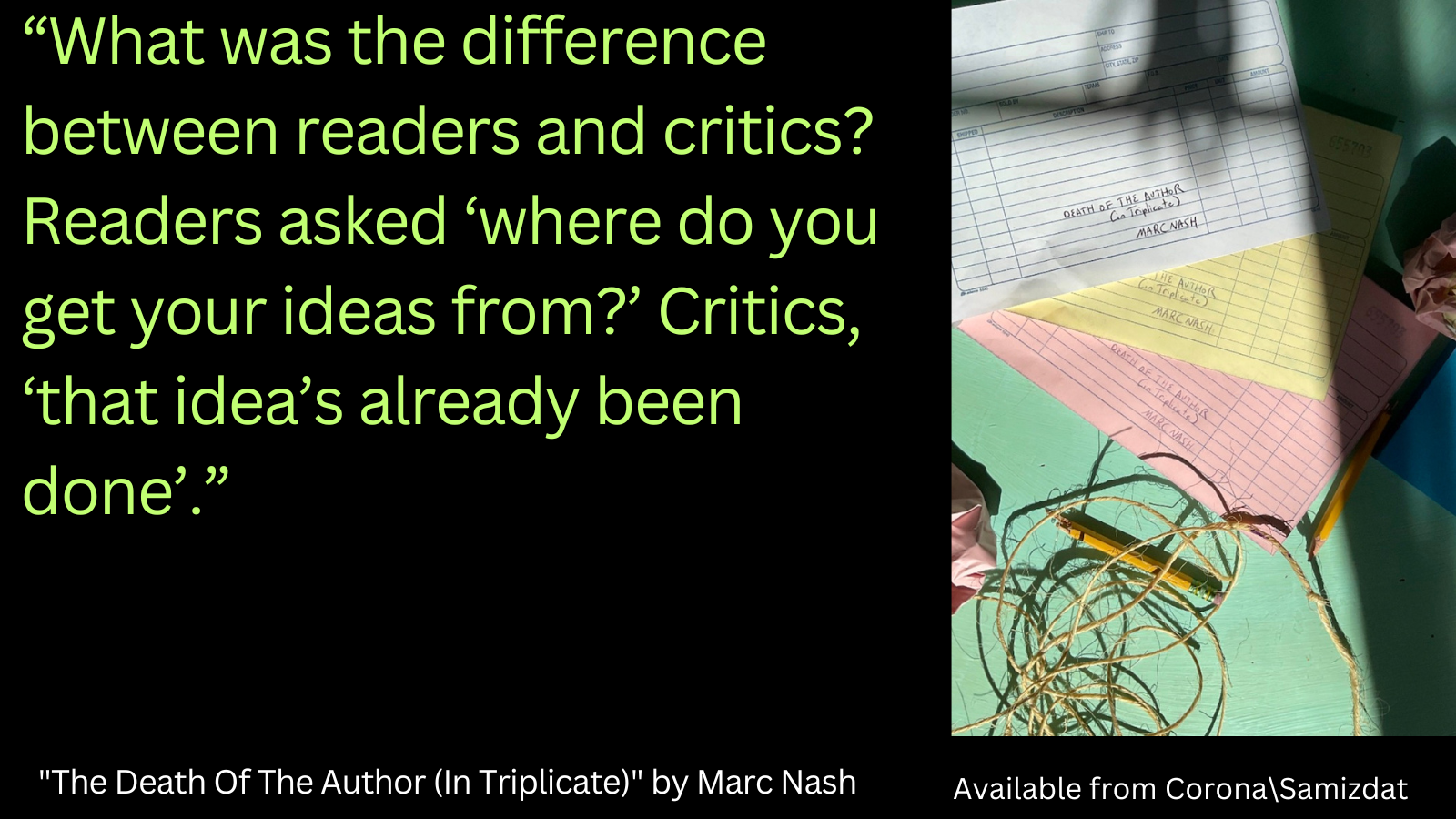


“The Death Of The Author (In Triplicate)”  is available direct from the publisher Corona\Samizdat  


Saturday, 29 September 2018

Tales From The Bogside - Flash Fiction


The Iron Age woman preserved perfect but leathery in the peat bog, now lay preternaturally mute on the temperature controlled examination table. Yet it was peremptorily determined she had to be the bearer of a story, so the reconstruction bard with a scalpel for pen, was charged with divulging it. To unfold the telltale signs of her composition. The graphology of her biography; her story; her history; his version of herstory. Using his nuclear tools to penetrate her unclear make-up.

Her tattoos professedly painted her an aristocrat, so she was dubbed a princess. An anthropological one rather than one borne of fairy tale, though no less mythic. A carbon-dated apologue from modern science’s non-apologists. Her backstory back-dated 28 centuries to compound the public’s interest. The voice from and of the past, the mother of the nation, itself bogged down by present day economic realities.

The hempen ligature around her neck excited proclamations of a summary execution. The expostulations centring on whether she had been dispatched as a human sacrifice, renouncing her life to put the tribe in good odour with the gods, or as mere criminal, which would give the lie to the previous cast of her caste. Less a matriarchal figurehead, more a primordial victim of domestic abuse. Competing modern day fablers speaking for her in a myriad tongues, when she herself possessed none; it having been removed around the time of her death, so she could not report from the afterlife and cavil with either god or carnal authority.  

Her tattoos were, in actuality, geometric. Imparting as much narrative delineation as the chance creases and folds of her flesh under the force of the fusty water. Though the bog had held decay at bay, the word in today’s parlance comes to stand for baulking progress. As has become the word ‘story’. (S-)tale. 


Thursday, 5 June 2014

Stained Glass - Friday Flash


He stood in the centre of the church’s murk. The heavy wooden pews were empty, but he conceived the devotees kneeling there would be swathed in darkness. Only the votive candles gave any illumination. Kindling the memories of the dead in order to light the ways of the still living. And thereby keeping them plunged in gloom.

As he moved he saw he cast no shadow. No place for light and shade in this particular realm he mused. He studied the stained glass windows. The only stab of colour in a world of black or white truth. The reds and blues were heavy and thick. They absorbed all the brightness from outside and devoured it. Imagine that, windows that actually served to stop up the light. The lapis lazuli ultramarine was very pure, untainted. While the cochineal reds were smoky, full of tiny grains. The reds were mainly used for the clothes of supplicants and the headwear of women, covering up the sinful flesh. Blue was for the garb of the saints. It was crystal clear to his eye the message of the glass. Only the halos were yellow and less dense, admitting a tiny amount of light to make them glow. 

He looked up into the heart of the cupola. There the colour was in the murals, while clear glass allowed the light to stream down into the upper reaches of the church in ribbons. The dizzying heights where man could not scale and approach the face of god. They would have to content themselves with contemplating him from far below on their knees. Looking up into the divine light as insects. The architecture of power was so transparent. How could people have fallen for this? Did they really believe this to be the natural order of how matter was arranged? One step outside of the church’s heavy wooden portal would have delivered them into the blinding sunlight of summer. That should have informed them of the artificial manipulation of light and dark they had just exited.

“Let there be light” the holy writ had commanded. So he picked up a floor candelabra and swung it at the stained glass. The glass shattered with a dull tintinnabulation. Ha he thought, let these serve as a call to prayer. He continued striking at each window in turn. The light outside seemed almost tentative, as if it were unsure whether flooding in might be a trespass. This only enraged him more.

“What are you doing?” spluttered the priest who had been summoned by the bruit. The man turned to face him and struck him with the iron candelabra. The priest fell straight to the ground groaning. The man leaned down and picked up a shard of the broken glass and drove it into the priest’s neck. The holy man’s white collar began to stain red. The red against the blood was of a light hue. The man studied the glass in his hand. It was a red slither and he regarded how the man’s blood was the same shade as the dark cochineal and couldn’t be picked out against it. Just as he imagined it would be. He drove it back into the man’s jugular.

He examined his hand as it too was bleeding. He was about to bring the cut to his mouth, when he caught himself. Leaded windows and five hundred year of insect dye was probably not conducive to his future wellbeing. He smirked and moved to exit the church. As his last act of desecration, he blew out each of the votive candles. Extinction was the only indisputable truth. He turned back into the interior of the church and was delighted to see that the light had apologetically begun to flow through the broken windows and begin to lift the gloom.

*


With slides spotted with red under microscopic lenses and the DNA drawn from his blood on the glass shard recovered from the dead priest’s neck, forensic science were able to bring the man to book. This was the natural arrangement of matter. And god’s, or was it man’s, arrangement of justice.


Thursday, 18 April 2013

The Idea Of A Man - Friday Flash


The mummified remains from the peat bog looked both like a man and yet very alien at the same time. The chemicals had preserved his body whole, but had tanned it like leather. It looked like one of Van Hagen's plasticised human art exhibits. His clothes were only preserved as shredded rags in places, but the bindings that shackled his hands behind his back were intact for all to see. Who was this man? Who had he been?


The detail of the fetters pricked people's imagination, as conclusions were drawn that the man had been executed as a prisoner. Or offered as a sacrifice. Science could analyse what the man's last supper had been. The remains of his clothes, or their accessories to be more accurate, suggested tantalising glimpses of his social status. His tattoos were felt to yield him a personal narrative depicted on his skin. The wear and erosion of his X-Rayed bones was interpreted for the way that he had walked and that he was left-handed. A profile of this man was built up and accordingly a name was conferred upon him so that everyone imagined they knew who he was. We conjured a full idea of who he had been. Had he known himself as much as we purported to know him? Had he looked inside himself as deeply as our forensic instruments?

There were queues snaking round the museum. A glass case, like a Damien Hirst bisected animal exhibit, contained the lithified remains of a man. A citizen of Pompeii, cured and petrified beneath volcanic ash. Who was this man? Who had he been?

No one of course, since his essence had long vaporised into the air. The ash had formed a perfect mould of his body, and the hollow mould had been cast with plaster of Paris to bring out his ghostly essence now on display behind glass. The idea and outline of a man. Slightly shrunken compared to our own contemporary well-nourished corpulence, his body bent into the unnatural angles of death. Hands protecting his featureless face, or perhaps clasped there in final prayer. Or maybe just blotting out the sight of impending oblivion. This sleeping man persecuted by unimaginably agonised dreams for eternity. Tourists travel to Herculaneum to see the lewd mosaics and graffiti, in order to transpose Pompeii's victims to the clues here about their lives. The wine coolers. The baths and water plumbing. They never saw it coming, but we have a pretty good picture. We fleshed him out, gave him a back story and inducted him into our collective history. This hollow man was now full of substance. Ornamentally displayed there under glass. Cast as an impure idea of a man who once might have been. Fired not in flesh but in gypsum. His body pockmarked with air bubbles and tiny gouges in the grain of his second skin. Turned inside out, like a death mask viewed from within. Glazed with our projections colouring him. Fusing him to our sensibilities rather than any he may have once held.


The TV channels had deemed that we couldn't view deep fried crispy human, but squashed flat as a pancake man was entirely palatable. Hence the cameras didn't zoom in on retreating armies burned in the cabins of their trucks and seared to the steering wheels by the heat of high explosive. However, the soldier who had presumably tried to flee from the troop carrier once the planes had been detected overhead, but ended up beneath the caterpillar tracks of his armoured vehicle, was fit for human goggle-box consumption. Who was this man? Who had he been?

He had been filleted, his vertebrae crushed beneath the multi-tonned vehicle, permitting the triumphant news crews of the victors to pun about his spinelessness. But his body had merged with the hardened banks of mud under the tracks, so that he was the same colour as the soil. It wasn't possible to determine if he was an unwilling conscript into this war, wrenched from his family, or a fervent defender of the motherland. Either way he was regarded as an implacable foe. Both sides could legitimately claim him as their kill. Whether he had perished underneath the tracks, a victim of friendly fire, or killed from above and his lifeless corpse tangled up in the desperately grinding caterpillar tracks, neither would be determined through any forensic autopsy, since this was reputedly not a crime scene. Despite the helpless turkey shoot it had turned out to be for the pilots and bombardiers.

He was scarce a man anymore, more of a caterpillar track. A skid mark. Fastened to mother earth, part of her topography, a contour of the local terrain. The war for the land, or more accurately the minerals and ores contained within it, had absorbed him into its maw. His bones pulverised, once again embosomed he could suckle toothlessly at the motherland's dried up-breast. An etiolated baby she offered up in her begging of favours from the victorious armies.

These men we never knew when they were alive. I'd say we only injected them with humanity posthumously, but posthumous etymologically speaking implies they were buried in soil, when of course two were merely shrouded by their murderous surroundings, while the third was blended into them. They were ashes to ashes, dust to dust on contact with their reaper. The only fleeting corporeality they evidenced was that they had died and ceased to be. That is the only pure idea of these men we were entitled to hold. Their quietus the sole element these mortal beings ever shared with us.


Friday, 29 March 2013

Acting Out - Friday Flash


He religiously viewed every programme he appeared in. He'd played detectives, uniforms, white-suited forensic officers, witnesses and persons of interest. (though for some reason, never the murderer, perhaps because of his good looks and the producers' executive decision that a murderer had to look evil). He could portray evil, he'd once played Iago at High School. But no dice, as with his whole acting career which had never taken off, not even second spear carrier in a local community production. Hence he'd eked out a career doing bit parts in crime reconstruction shows.

All the roles he'd played, shared the same fate as that of the corpse, (which he'd also played on occasion), you never heard their words. You heard them speak, but their actual words were muted low in order that the voice-over cut across it. He never understood why sometimes they were even given scripts, or else encouraged to improvise, if the words didn't matter a dime. The real detectives and forensic officers were the voices that demanded to be heard. They were placed central in the mix. And through their expertise, the corpse got to tell its story after all. So in the final reckoning he was always more mute even than the corpse.

But not today. Today he was dressed in a sheriff's uniform and armed with a badge. Yet he wasn't on any set, nor even on a location shoot. They may have been making shows where attention to the smallest detail was uppermost, but TV production companies were rather lax about their own security. And so he had smuggled out a uniform. Was the badge authentic? It would be good enough to gain him ingress.

The uniform he'd plucked meant that his next appearance would have to be in Texas. Inevitably, it would only be Texas or California. No point him stealing a uniform of law enforcement in Delaware or Oregon, the serious crimes there were too few and far between. No, thank god for the bloodlust of Tx and Ca.

He'd driven for three nights to get to the right county to match his assumed jurisdiction. He was proved correct when the combined authority of the uniform and badge granted him an invite across the threshold of the remote farmhouse. He withdrew the knife, (the gun that came with the borrowed uniform was only a replica) and plunged it into the belly of the man. The victim slumped to his knees, but the would-be killer knew that he had to move into overdrive. For he had to set the scene for the experts.

In the case of a home invader disturbed in the act, the tendency would be for a quick stabbing and then fleeing the scene, since the primary aim was burglary, not murder. The randomness of how the killer and the victim come to be brought together makes it hard for the police to get to the identity of the former, because there is no overt connection. But this is where his plotting kicked in. Though this was to be a stranger killing, he wanted to muddy the waters further, to throw the so-called professionals off the scent.

Hence he thrust the knife once more into his helpless victim. He tried to work up a frenzy of stabbing, but he found it tough going. (He had considered trying the act with his left-hand, but he wasn't confident that having never stabbed anyone before that he could successfully execute it wrong-handed). The knife seemed heavier and more resistant each time he tried to extract it from the man's flesh. He would have thrown up, had he not summoned up his old Stanislavski technique to offset the physical repulsion with some happier affective memories.

Finally the man toppled over fully and he listened for his death rattle as the breath ebbed away from him. Now came the time for full misdirection. The excess of sharp force trauma might suggest a psychopathic killer. He had idled with the thought of imitating an extant serial killer's MO, but he knew from the shows that copycats never quite reproduced the signature of their inspiration which always tripped them up as clumsy imitators. Besides, this was all about making his own voice heard for once, though of course no one was to know that it was his voice. He had also flirted with the notion of bringing misleading clues to drop at the scene, but his research had shown that The Manson Family's attempts to misdirect with random objects and bloody messages daubed in blood had ultimately helped guide the police to them. No extraneous props. They tripped murderers up as much as they did actors on stage.

He wanted to suggest that he and the murderee were in fact acquainted. But the bluff and counterbluff would be enhanced by pretending to cover it up as a stranger murder, like a home invasion gone wrong. Donning his gloves, he rifled through the house, careful to look as though he was searching for riches, but leaving obvious boons intact. Thus tipping off future investigators that robbery was not really the motive.

Then there was his mode of entry. While flashing his badge had allowed him unforced entry, he now had to counterfeit a burglar's entrance. He went to the French Windows and let himself out through them. You'd be surprised how many fools punch out the glass from the inside so the shards fall outside. Dead giveaway that it's been done after the event. Even those smart enough to punch out the glass from the outside, don't realise that the CSI guys can tell whether that glass has been walked on or remains pristine. If the latter, it means no robber came in through the windows. So he marched through the broken glass strewn across the carpet.

Satisfied with his own mental check-list, he peeled off his clothes and put them into a bag. He would conceal them in full-sight back at a TV studio, simply adding them to the laundry basket of soiled costumes. He wasn't sure if they were thoroughly cleaned or just thrown out as unusable. Those that had screen blood and gore caked on to them at least. And another benefit of dear old Texas, was that his wide-brimmed sheriff's hat had allowed him to secrete a hair net beneath, thus ensuring there were no stray strands of DNA-laden hair to betray him.

One final survey around the crime scene determined that his Method had been faultless. His only regret was that as the case was likely never to be solved, he had no chance of appearing in a programme reconstructing it in the future.