Showing posts with label Sartre. Show all posts
Showing posts with label Sartre. Show all posts
Thursday, 15 November 2018
A Literary Scavenger Hunt Around Paris
Join me for my Paris vlog - invited there for an event, I took the opportunity of checking out a couple of Paris' most famous literary spots. Musing on art and death in Montparnasse Cemetery and generally being an Englishmen abroad. Enjoy!


Wednesday, 16 August 2017
Can A Writer Also Be An Activist?
I salute the authors and publishing professionals who responded to the Grenfell Tower disaster by setting up an online auction which raised three and a half times its £50,000 target. An impressive, heartfelt humanitarian response. Yet not a political one. Indeed the victims have said that funds are not the issue, instead demanding answers as to the causes of the tragedy and lobbying Sir Martin Moore-Bick’s inquiry for the widest terms of reference possible. Society-wide terms so that they can determine their place and value in a society where the Grenfell fire can rage in so devastating a manner.
The word author is hard to yoke to the word activism. Writing is a sedentary occupation, save for the odd writer like Hemingway standing up to write in a physicality vaguely suggestive of a manual trade. Potters are also sedentary artists, but in addition to their hands, one of their feet is working to rotate the wheel. Writing retreats are very popular with authors, the opportunity to get away from the distractions of the everyday world in order to pen your words within the cocoon of Nature, Wordsworthian or not. I can’t see how this would foster the atmosphere of a gritty urban thriller, but then I don’t write them.
Musicians don’t seem to be so hamstrung from activism. After all they are most active in their stage performance, they are bound by distinct rhythms (unlike the rhythms silently imagined by the author sat at their desk) and slogans can be handily and catchily bound up in simple chants drawing on popular songs. Jeremy Corbyn gets a rousing reception at Glastonbury, while in London’s inner boroughs, Grime artists will tell you it was them what mobilised the youth vote for their main man MC Jezza. However, the audience for books is a discrete one, since reading is undertaken alone and rarely does an author have a stage bringing together the numbers to convene the significant assemblage of a band in concert or at a festival.
Authors don’t have to be excluded from being viewed as activists. In France, Sartre, de Beauvoir and Camus were at the head of any 1960s political demonstration going. Novelist André Malraux had a stint as the Minister of Cultural Affairs. But Britain lacks for much of a recent history of activist authors. Harold Pinter and Lady Antonia Fraser were notable exceptions, but part of their activism occurred through high end dinner parties. JK Rowling publicly expresses her political views through social media, but was recently rounded on by fellow author Joanna Trollope for such action representing a mere indulgence of ego. Or worse, that exploiting her popularity to leverage support for a cause, somehow strikes at the gravitas of serious wordsmithery.
It’s not hard to write a political novel. But it’s hard getting the timing right for its relevance, seeing that a week is a long time in politics and issues perpetually change and move on. So if you wanted to sit down and write a book provoked by the tragedy of Grenfell Tower, it would be ready to hit the bookshops probably only marginally before any official government inquiry had reached its conclusions; yes that long! Firstly it takes at least a year for an author to write a complete work from scratch and that’s assuming they either have it plotted out, or a pretty good idea of it if they tend to eschew planning. Then if they have a deal with one of the big publishing houses, their work will probably be slated for release two years hence, so far in advance are publication schedules. A seemly group of pop stars can gather in a recording studio and record a song to highlight a cause in a single working day, digitised and downloadable within the same week. Of course an author can take to Kindle and swiftly publish a single short story, or publish it on their own website, but it’s just not going to have the same impact. And save us from another hastily put together rapid response anthology of stories, that bear no relationship to one another, let alone to the cause espoused in the introduction.
But then timing is always an issue in any art form that seeks to engage with the world. JG Ballard wrote three books between 1973-75 inspired by the very urban landscape and architecture of that part of North Kensington where Grenfell Tower is situated. “Crash”, “High Rise” and “Concrete Island” are seeped in the trunk road The Westway, around which North Kensington’s tower blocks stand upright and austere. Each book involves a political and psychological analysis pertinent to the issues of the area, that were finally laid bare by the flames that engulfed Grenfell Tower. Yet Ballard’s vision predated even the hand wringing and finger pointing back to the politics of the 1980s by a full decade. Yet Ballard was not overtly an activist. And that is the point of the political novelist, the activist writer. You have to be in it for the long haul. You can’t simply dip in and out when a single issue gets your political gander up and provokes you into a literary (or fundraising) response. You’re never writing about your themes completely from scratch, but as part of your continuum of subjects. Ballard's artistic and philosophical influence continues through the writers and film-makers who channel his ideas today.
The true activist author keeps chipping away with his or her critical vision, with their constant commitment to looking beneath the surface of society and one day maybe, their ideas come into fashion for their ‘timely’ resonance. An activist author can address rallies, go on “Newsnight" to debate with an MP, take to Twitter, or pen an opinion piece for a broadsheet. But ultimately, their activism is really their sustained body of work in the political sphere, using fiction to speak to truth.
For my piece on just how we end up at a Grenfell Tower disaster, read here.
Monday, 8 June 2015
My Ten Favourite Stage Plays
Before I wrote fiction, I wrote stage plays. I used to see a lot of contemporary plays staged and also read a lot of scripts as part of my self-education programme. Though I don't go to the theatre much these days, here is a chart of my favourite plays. I've only included plays from the post-Second World War period onwards, otherwise it might be pretty Shakespeare & Brecht heavy in the chart!
10) "Royal Hunt For The Sun" - Peter Schaffer
I only ever read this rather than saw a performance, but I remember being struck by the amazing visual images that came across from the stage directions alone, the main one being a giant sun. It's the story of conquistadores in Latin America and the political dance around the Meso-American god-king to try and ensure a successful conquest with a tiny amount of men against a whole nation.

9) "No Exit" - Jean-Paul Sartre
I love Sartre more as a playwright than a novelist. But in truth most of his plays while readable, are unperformable. However this perfect little nugget of a play sees the threeway power struggle of prisoners in a locked room, trying to manoeuvre for power even though they have none in their situation. By turns they seduce, wheedle, cajole each other, always forming and breaking alliances. It's an early precursor of the "Big Brother" TV show, only with a killer pay-off line, "Hell is other people".

8) "The Balcony" - Jean Genet
Genet understood the illusion of the theatre better than most and a recurring theme of his was characters dressing up and acting as other characters. Here a revolution is taking place, but the action is being mirrored in microcosm inside a brothel, where punters are dressing up in fantasy roles as Judge, General and Priest, replacing the very same outside who have become victims of the coup, thus perpetuating the status quo. Sex, death and corruption, what more could you want on stage?

7) "Accidental Death Of An Anarchist" - Dario Fo
You've got to have a bit of humour haven't you? I always thought theatre audiences were so desperate to laugh, they would go into fits at the weakest of jokes in tired drawing room dramas. But this was a genuinely funny, laugh throughout the 90 minutes satirical farce with some acute political observations. All the more remarkable that it was based wholly on an incident from Italy and dissected Italian politics, yet it absolutely managed to translate both its message and its comedy to other countries. Part of this was down to recognisable character types, such as the dim-witted policeman, or the hero who disguises himself, the sultry temptress, but the nature of farce itself is also quintessentially recognisable.

6) "Comedians" - Trevor Griffiths
I only saw a student production of this, but it was still terrifying and visceral. A play about alternative comedy before anyone had even come up with that term. The premise is that an old pre-war comic is coaching a night-class of comedian-wannabees for a talent show night, when his star pupil throws his whole act in the bin and performs a brutal and in the face of the audience menacing routine instead. The only weakness of the play is the short and cop-out third act, when the old comic talks about the nature of humour set against and grounded in his own experiences of liberating a concentration camp when he was in the British army. I don't think that apologetic third act was required at all.

5) "White Rose" - Peter Arnott
I saw this at the Edinburgh Fringe Festival and of the 40 shows I crammed in my time there, this was head and shoulders the best. But you won't even find a copy of the script available on Amazon. It was in a theatre so small that it didn't even have a stage, but that perfectly suited its small scale for 3 actors. Set in World War Two Russia, a male fighter pilot, a female fighter pilot (the eponymous 'White Rose' and their shared female engineer, beautifully enact their triangular relationships, taking in the war, gender, love, patriotism, politics and just what it means to be human in the face of extremes and the prospect of death.

4) "AC/DC" - Heathcote Williams
The enfant terrible of the UK stage in the 1960s, which is saying something given the obsession with sex that abounded once plays were no longer censored by the offices of the Lord Chamberlain after 1968. This play was so prescient about all things that would go on to become our obsession with celebrity. It's visceral and yet has stunningly powerful visual imagery. I'm not sure how it would hold up to scrutiny today, simply because what it portrayed has now become so commonplace. But a work of genius to be sure.

3) "Marat/Sade" - Peter Weiss
A powerful play about the French revolution and how political dissidents were locked up in insane asylums. Thus it explores that boundary between revolutionary/radical thinkers and the mad, while also examining the propensity for change within the individual and across whole societies.

2) "Geography of a Horse Dreamer" - Sam Shepard
I think of all playwrights, Shepard has my favourite body of work. It's hard to pick just one. But there were a few plays he wrote in exile in the UK, looking back at his home country of the US and this is one from that period. It's small but perfectly formed, as a cowboy is kidnapped by gangsters because he has a special gift for forecasting winning racehorses so they can clean up at the bookies. However, cut adrift from his Wyoming home, the cowboy is losing his mind and his touch, whereupon the gangster captor is getting more desperate to restore his powers, while his doctor sidekick is more keen to isolate the creative energy by culling his body parts. The cowboys' brothers turn up to rescue him and return him to the range. Shepard's psychic pain at being cut off from his own home roots are encapsulated in this perfectly.

1) "Endgame" - Samuel Beckett
No one 'got' theatre like Beckett in my opinion. I think because real life amused him and was absurd and illusory as the stage itself. Life was a play and not a very logical or coherent one at that. Everyone cites "Godot" of course, but I believe this is a far superior play. One character Hamm is unable to stand, his antagonist Clov unable to sit. Hamm's parents both live inside dustbins. It's bleak and dystopian and nihilistic but it is also funny and moving and has stark, stripped down visually imagery that is so powerful. When life is so painfully absurd, all you can do is laugh at it, which is exactly what Beckett has us do. It's one of those plays that is so all-absorbing, the audience are no less captives in the theatre than the characters on stage, until the houselights come up to release them... into a world as absurd and illogical outside the theatre's doors. For the duration of the play, there is no outside world, no fourth wall of separation. A masterpiece.

10) "Royal Hunt For The Sun" - Peter Schaffer
I only ever read this rather than saw a performance, but I remember being struck by the amazing visual images that came across from the stage directions alone, the main one being a giant sun. It's the story of conquistadores in Latin America and the political dance around the Meso-American god-king to try and ensure a successful conquest with a tiny amount of men against a whole nation.

9) "No Exit" - Jean-Paul Sartre
I love Sartre more as a playwright than a novelist. But in truth most of his plays while readable, are unperformable. However this perfect little nugget of a play sees the threeway power struggle of prisoners in a locked room, trying to manoeuvre for power even though they have none in their situation. By turns they seduce, wheedle, cajole each other, always forming and breaking alliances. It's an early precursor of the "Big Brother" TV show, only with a killer pay-off line, "Hell is other people".
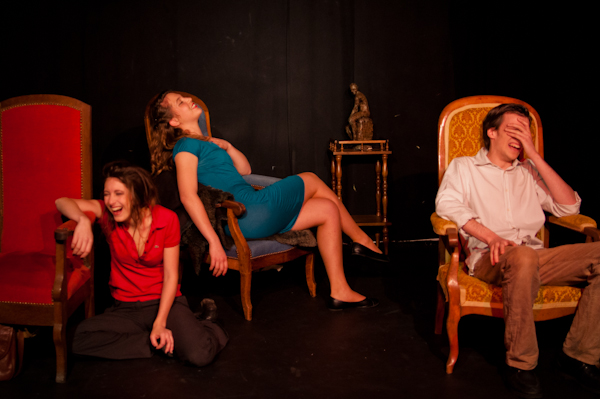
8) "The Balcony" - Jean Genet
Genet understood the illusion of the theatre better than most and a recurring theme of his was characters dressing up and acting as other characters. Here a revolution is taking place, but the action is being mirrored in microcosm inside a brothel, where punters are dressing up in fantasy roles as Judge, General and Priest, replacing the very same outside who have become victims of the coup, thus perpetuating the status quo. Sex, death and corruption, what more could you want on stage?
7) "Accidental Death Of An Anarchist" - Dario Fo
You've got to have a bit of humour haven't you? I always thought theatre audiences were so desperate to laugh, they would go into fits at the weakest of jokes in tired drawing room dramas. But this was a genuinely funny, laugh throughout the 90 minutes satirical farce with some acute political observations. All the more remarkable that it was based wholly on an incident from Italy and dissected Italian politics, yet it absolutely managed to translate both its message and its comedy to other countries. Part of this was down to recognisable character types, such as the dim-witted policeman, or the hero who disguises himself, the sultry temptress, but the nature of farce itself is also quintessentially recognisable.
6) "Comedians" - Trevor Griffiths
I only saw a student production of this, but it was still terrifying and visceral. A play about alternative comedy before anyone had even come up with that term. The premise is that an old pre-war comic is coaching a night-class of comedian-wannabees for a talent show night, when his star pupil throws his whole act in the bin and performs a brutal and in the face of the audience menacing routine instead. The only weakness of the play is the short and cop-out third act, when the old comic talks about the nature of humour set against and grounded in his own experiences of liberating a concentration camp when he was in the British army. I don't think that apologetic third act was required at all.

5) "White Rose" - Peter Arnott
I saw this at the Edinburgh Fringe Festival and of the 40 shows I crammed in my time there, this was head and shoulders the best. But you won't even find a copy of the script available on Amazon. It was in a theatre so small that it didn't even have a stage, but that perfectly suited its small scale for 3 actors. Set in World War Two Russia, a male fighter pilot, a female fighter pilot (the eponymous 'White Rose' and their shared female engineer, beautifully enact their triangular relationships, taking in the war, gender, love, patriotism, politics and just what it means to be human in the face of extremes and the prospect of death.

4) "AC/DC" - Heathcote Williams
The enfant terrible of the UK stage in the 1960s, which is saying something given the obsession with sex that abounded once plays were no longer censored by the offices of the Lord Chamberlain after 1968. This play was so prescient about all things that would go on to become our obsession with celebrity. It's visceral and yet has stunningly powerful visual imagery. I'm not sure how it would hold up to scrutiny today, simply because what it portrayed has now become so commonplace. But a work of genius to be sure.

3) "Marat/Sade" - Peter Weiss
A powerful play about the French revolution and how political dissidents were locked up in insane asylums. Thus it explores that boundary between revolutionary/radical thinkers and the mad, while also examining the propensity for change within the individual and across whole societies.

2) "Geography of a Horse Dreamer" - Sam Shepard
I think of all playwrights, Shepard has my favourite body of work. It's hard to pick just one. But there were a few plays he wrote in exile in the UK, looking back at his home country of the US and this is one from that period. It's small but perfectly formed, as a cowboy is kidnapped by gangsters because he has a special gift for forecasting winning racehorses so they can clean up at the bookies. However, cut adrift from his Wyoming home, the cowboy is losing his mind and his touch, whereupon the gangster captor is getting more desperate to restore his powers, while his doctor sidekick is more keen to isolate the creative energy by culling his body parts. The cowboys' brothers turn up to rescue him and return him to the range. Shepard's psychic pain at being cut off from his own home roots are encapsulated in this perfectly.
1) "Endgame" - Samuel Beckett
No one 'got' theatre like Beckett in my opinion. I think because real life amused him and was absurd and illusory as the stage itself. Life was a play and not a very logical or coherent one at that. Everyone cites "Godot" of course, but I believe this is a far superior play. One character Hamm is unable to stand, his antagonist Clov unable to sit. Hamm's parents both live inside dustbins. It's bleak and dystopian and nihilistic but it is also funny and moving and has stark, stripped down visually imagery that is so powerful. When life is so painfully absurd, all you can do is laugh at it, which is exactly what Beckett has us do. It's one of those plays that is so all-absorbing, the audience are no less captives in the theatre than the characters on stage, until the houselights come up to release them... into a world as absurd and illogical outside the theatre's doors. For the duration of the play, there is no outside world, no fourth wall of separation. A masterpiece.

Thursday, 8 January 2015
Charlie Hebdo and artists' dereliction of duty
So suddenly we’re all Charlie and we’re all in solidarity with freedom of expression. Sorry, not buying a word of it. In Britain artists of print, stage, music and whatever passes for indigenous film have all fought shy of the political in their subject matter. With a few honourable exceptions, not least within the cartoon and graphics community and the odd stand-up comic (Jerry Sadowitz reviled for his extreme comedy, ‘outed’ Jimmy Savile in his act 30 years before society caught up to him).
In Britain ever since Mrs Thatcher demanded that our art be self-financing so that market demands shaped content, and also since the arts community miserably failed to get to grips with the ideology of Thatcherism with god-awful ‘little’ films about relationships set against the backdrops of riots or demos, we have increasingly detached our artistic output from having any political message at all. And this was in the decade of the Rushdie Affair let us not forget. The ironic thing is that in an era when public discourse on anything has been eroded by the authorities (Blair happily carried this on from Thatcher), art failed miserably to step in to fill the breach. (Nor can twitter usefully redress the balance for that matter). The fact is our artists have been censoring themselves for the past twenty years, be it for economic or political reasons. And now we are proclaiming that we are all about the right to express oneself freely…
In continental Europe, they just don’t even make the distinction between art and politics. Camus, Sartre and De Beauvoir went on every march going, while Malraux was Culture Minister in the government. Can you imaging an Amis leading a demo, either Kingsley or Martin? Sadly now that Harold Pinter has passed, there is no one to lead our artistic intelligentsia and get them out on the street (although he tended to favour agitation by dinner party). Europe’s refusal to categorise art as political and separate is exactly why you can have a radical magazine like Charlie Hebdo exist in the first place. But as more and more artists cede the political ground through fear of reprisal (or libel), then that leaves fewer arts’ bodies, each operating in isolation and therefore very vulnerable to attacks such as these. If there were a myriad of arts organisations making challenging, provocative, radical art, then those offended by it wouldn’t be able to strike at them all. They wouldn’t know where to bloody start.
You want to show solidarity? Make some flipping political art for a change. I know I have. It’s what I do.
Thursday, 5 April 2012
The Haunting Of The Self - Friday Flash
"Hell is other people" opined Jean-Paul Sartre. Hell on earth maybe. But in the afterlife, can we even call it that, can I call it that...? There is certainly no other company to pin the blame on. The posthumous life is an isolated one.
Can you live with yourself? For eternity I mean? And it's not even that hoary old notion of an endless replaying and mulling over your recently departed life, what you did right, what you did wrong. I do reference the odd event from my former existence here and there, but only in parentheses. Mere flotsam in the remorseless torrent of thought that afflicts me in my current disposition. Certainly nothing to gain a firm hand hold on to anchor one upon sure-footedness. For here, wherever here is - concepts of fluffy clouds or burning hellfires have both proved fancifully baseless - though my exact configuration is no less nebulous - the mind is never switched off.
For there is no sleep. No room for idle daydreaming. Never a pause to eat, or relieve oneself. Except of mental effluence. Though actually there is no relief even to be had there. The spate streams on. Mindlessly one might even say. Though the thought is coherent. Self-reflectively so. On the niggling status of the thinking being. For it is uncoupled from any corporeality. Therefore it-I, lack any spatial dimensions. And we have already established that there is no temporal one either. For only with the body's mechanical, clockwork needs does time have a rhythm against which to regulate them.
It's odd. Now that I'm stripped of a physical vessel with all its cacophonous feedback chatter, so that the mind is free to cogitate unimpeded, it is not the purpose of my past life that it contemplates, but its current uncertain status. Without a sensory apparatus, it- I can gain no new information, so can only draw on what has gone before, which I have seemingly relegated to background trivia, or else the purely abstract. How approaching death we once raged at the great cosmic joke played on our species, of the life spent building relationships, lives, loves and the whole of material reality, only to have it snatched away by the most final of cessations. When in fact we appear now to have been looking at it the wrong way around. Condemned to some sort of existence here, where nothing ever terminates. Would that it did. To obtain a rest from this incessant onslaught of rumination. Maybe the Buddhists on earth had it right, with their meditation seasoning them for this. Granting them the ability to impregnate pauses and garner silences. The stilling of the spirit. Mind you, no sign of their other belief in reincarnation. Of heading back into the corporeal fray wrapped in a new skin.
So the body is shucked, but the psyche still seems to persist. Even more obsessively if that's even possible. So one begins to sift as to what mind is- was. It used to be charged with steering the body through the vicissitudes of life and promoting the common weal. Knitting together perceptions, memories and feelings into a relatively unified and consistent core identity. Presently it seems involved in a perpetual inquiry as to its own nature, with reference and comparison to what it was when cased in flesh. The mind interrogating itself.
Back down there- not that directionality has any meaning anymore, the mind was the collective set of impressions and interpretations yielded by the senses, filtered through emotions and all sorts of brain chemistry. Yet here, presumably I lack for the physical brain, the electrical synaptic pulses, the chemical baths. So where is this "I" housed? What is enabling it to persist beyond physical form? Am I haunting myself? The location I refuse to rescind is not a place on earth, but my own ego. Despite the battering it has taken through expiration and disseverance.
And that's what it-I do. In a never ending loop. A Moebius Strip of reflexivity. Turning itself over and over, inside out, yet never being able to penetrate itself. If life was mockingly fleeting back on earth, what of it now? Locked into trying to see what any of it is all for, such singular purpose seemingly being only the continuous and flawed search itself. Hell isn't other people. It's the stripped down, bare self. The agony of partial being. It is the realisation that one has only ever been an abstraction, unable to present itself into full awareness of what it actually is, or what it represents.
Can you live with yourself?
Subscribe to:
Posts (Atom)